Crochet slippers pattern — two pieces, 44 rounds written out

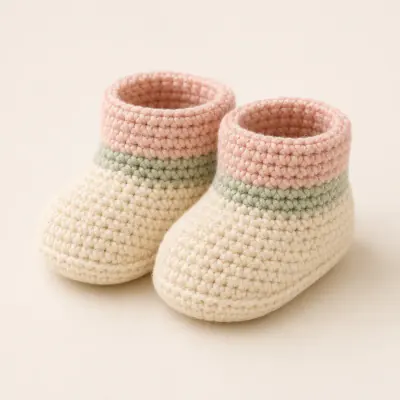
A free crochet slippers pattern for a chunky pair with a 25 cm sole about 15 cm tall, finishing in a 49 cm cuff that sits loose and folds down, worked on a 7.0 mm hook in three colours over about five hours. The sole grows from 32 stitches to 56, round 6 goes into the back loops only to stand the wall up, and then rounds 15, 16 and 17 each put four decreases across the instep — twelve stitches taken out over one span is what bends the tube down over the foot rather than leaving it standing as a bag. Both slippers are written out in full, 22 rounds each, every round carrying the count it ends on.

Maths verified, not yet made. Every one of the 44 rounds was checked against the round before it by machine — the counts, the increases and the decreases all add up. What nobody can promise you yet is how it sits in the hand.How we check
6 of 8 checks ran on 2026-09-04
  • 1 format and stitch chainscripts/validate.py — 113 patterns, all counts chain.
  • 2 catalogue auditscripts/audit-patterns.py — 113 audited, 0 errors, 66 warnings.
  • 3 geometrygeometry-check.py — 113 checked, 0 errors, 4 warnings.
  • 5 not a duplicate113 distinct display names across 113 patterns
  • 6c target on the recordseo.headKeyword, confidence and demand present and cross-checked by scripts/validate.py
  • 8 page readinessscripts/check-completeness.py --gate — 0 required fields missing, 114 editorial flags, 0 unearned claims.
Not yet checked
  • 4 render matches the pattern — no image has been compared against its own prompt, so a render showing a piece the rounds do not make would not be caught here. Nothing has counted how many do.
  • 6a recognisability — provenance.recognisability is empty in every pattern, so there is no feature list to check the parts against.
Why it is rated Medium

Medium: the twelve instep decreases have to fall over the same span on both slippers, and the back-loop round on 6 is the only thing separating the sole from the wall.

Sell what you make. Anything you crochet from this pattern is yours to sell — any quantity, no fee, no credit required.

00
00

What you need before you start

gather it once, in one place
Expand

Yarn — three colours, all weight 5

Charcoal~40 m (about 35 g)Bulky weight (CYC 5) acrylic or wool blend
Cream~105 m (about 90 g, one ball)Bulky weight (CYC 5) acrylic or wool blend
Mustard~45 m (about 40 g)Bulky weight (CYC 5) acrylic or wool blend

Tools

5 you probably own, 1 to buy

You likely have

Tapestry needle
Scissors
Stitch markers
Measuring tape
Row counter

You need to buy

Silicone non-slip dots or a small tube of puffy fabric paint for the soles

Optional

Two stitch markers in a contrast colour to mark the instep
Suede or leather sole pads sized to a 25 cm foot

Gauge and finished size

the last check before you cast on
Tension
Gauge sets the shoe size here, so work the five sole rounds, lay the sole against the foot it is for, and change hook before you go up the wall. A sole that is right and a wall that is wrong is still a slipper; the other way round is not.
Finished size
~25 cm sole and ~15 cm tall, with a cuff of about 49 cm that sits loose and folds down — an adult 7-8
The pair is written for a 7.0 mm hook. Dropping to 6.5 mm gives a slipper about a size smaller without changing a single count, since the sole is 56 stitches either way — a hook change is the only way to resize this one.

How to make the slippers, piece by piece

44 rounds across two pieces, from one list: one is worked twice.

Switching rewrites every round:US32 sc around the foundation chain→UK32 dc around the foundation chainWork a US sc as a UK single crochet and the fabric comes out looser and taller.
1
01

The slippers

Two the same. An oval sole out to 56 stitches, a back-loop round to…22 RNDS
starts in charcoal· picked up· Piece 1 of 2

Two the same. An oval sole out to 56 stitches, a back-loop round to turn the wall up, a straight cream shaft with mustard dashes, then the instep decreases that make it a slipper rather than a bag.Pick acrylic over wool here. Wool felts and shrinks at anything warmer than a cool wash, and a slipper is the one thing you cannot size up again afterwards. A row of silicone dots along the sole is what makes them safe on a wooden floor.

Rounds 1 to 6 of The slippers: 32, 38, 44, 50, 56, 56 stitchesFirst six rounds[32] [38] [44] [50] [56] [56]

The oval sole, out to 56

RND 1–5
132 sc around the foundation chain[32]
2(inc, 4 sc) around, 6 inc[38]
36 inc spread evenly[44]
46 inc spread evenly[50]
56 inc spread evenly[56]

Cream wall, mustard dashes at 10 and 11

RND 6–14
656 sc, back loops only, cream[56]
756 sc[56]
856 sc[56]
956 sc[56]
1056 sc, mustard dashes[56]
1156 sc, mustard dashes[56]
1256 sc[56]
1356 sc[56]
1456 sc[56]

The instep, twelve stitches out

RND 15–17
154 dec across the instep, 48 sc[52]
164 dec across the instep, 44 sc[48]
174 dec across the instep, 40 sc[44]

The mustard cuff

RND 18–22
1844 sc, mustard[44]
1944 sc[44]
2044 sc[44]
2144 sc[44]
2244 sc[44]
US termsscsingle crochetincincreasedecdecreaseBLOback loops onlyst(s)stitch, or stitches
When this piece is doneOne slipper down.Try it on before you start the second. If the sole ran short, go up a hook size for the pair rather than adding rounds — the counts are what keep the two identical.
2
02

Right slipper

— the same 22 rounds again, worked from piece 0122 RNDS
starts in charcoal· picked up· Piece 2 of 2· mirrors the slippers

The same 22 rounds as the slippers, worked a second time.

Rounds 1 to 6 of Right slipper: 32, 38, 44, 50, 56, 56 stitchesFirst six rounds[32] [38] [44] [50] [56] [56]
132 sc around the foundation chain[32]
2(inc, 4 sc) around, 6 inc[38]
36 inc spread evenly[44]
46 inc spread evenly[50]
56 inc spread evenly[56]
656 sc, back loops only, cream[56]
756 sc[56]
856 sc[56]
956 sc[56]
1056 sc, mustard dashes[56]
1156 sc, mustard dashes[56]
1256 sc[56]
1356 sc[56]
1456 sc[56]
154 dec across the instep, 48 sc[52]
164 dec across the instep, 44 sc[48]
174 dec across the instep, 40 sc[44]
1844 sc, mustard[44]
1944 sc[44]
2044 sc[44]
2144 sc[44]
2244 sc[44]
US termsscsingle crochetincincreasedecdecreaseBLOback loops onlyst(s)stitch, or stitches
Two pieces from one list. One list — the slippers — is written once and worked twice, identical round for round; the grey bars are piece length, all drawn to the same scale.44 ROUNDS IN ALL

Eight notes on the slippers

Read them
01An original Crochet Genie design.
02The fabric is plain single crochet the whole way through. It comes out smooth and even, with no ribbing and no gaps anywhere — the shape comes from the increases and decreases, and the interest comes from the colour.
03Round 6 is worked in back loops only. It is still 56 single crochet, 56 stitches in and 56 stitches out, so the counting screen shows it as a plain round. Working the back loop is what leaves a ridge around the edge of the sole and stands the wall up.
04Round 1 stands in for an oval foundation: chain 13, work 15 sc down one side of the chain and 17 back along the other for 32 stitches. The app counts it as a plain round of 32 with no ring to close, which is why this part has no magic ring.
05All four decreases in rounds 15, 16 and 17 belong across the top of the foot. Mark the front third of the round before you start shaping and keep every decrease inside those markers. Twelve decreases landing in that one place is what bends the tube down over the instep — there is no heel flap and no rows worked back and forth.
06Rounds 10 and 11 carry the dashes: 2 mustard, 5 cream, eight times around. Carry the colour you are not working along the top of the round and cover it with the stitches, so no ends need weaving.
07The two slippers are identical, round for round. Nothing is sewn to anything — each one comes off the hook finished.
08Worked in a continuous spiral from the sole upward, so there is nothing to join and nothing to work back and forth.

Four questions this pattern answers

Not questions anybody asked. Each one is written from this pattern's own record, and every answer is read off the fields it names.
How is the colour worked into the slippers?

Inside the round, not at the start of it: four of the 44 rounds carry a colour run, in every piece. Each of those rounds gives the run in stitches: round 10 of the slippers is sixteen runs of colour, beginning two mustard, then five cream, and so on round the piece.

How much yarn will the slippers take?

Three colours, all weight 5 (bulky), and the pattern asks for charcoal: ~40 m (about 35 g); cream: ~105 m (about 90 g, one ball); mustard: ~45 m (about 40 g).

What hook will the slippers need, and what is the finished size?

A 7.0 mm hook. Finished, it comes out ~25 cm sole and ~15 cm tall, with a cuff of about 49 cm that sits loose and folds down — an adult 7-8; the leading tilde is there because that came off the stitch counts rather than a tape measure.

How long will the slippers take to crochet?

About five hours. That is 44 rounds across two pieces, coming to 2,056 single crochet, 48 increases and 24 decreases, and the hours are an estimate rather than a timing of anybody making it.

A round that will not add up?
Tell us the piece and the round number — the stepper already knows where you are.There is nowhere to send one yet.
Report a problem
Put the laptop down mid-round
The iPhone app keeps your place — and hands it back where you left it.
Get the app

More home patterns

All 113 patterns
Piece 1 of 2The slippers0 OF 44 ROUNDS WORKED
Round1/2232 sc around the foundation chain[32]